 remb
rembDocumentation Index
Fetch the complete documentation index at: https://resend.com/docs/llms.txt
Use this file to discover all available pages before exploring further.
Custom events are used to trigger automations and can be defined with an optional schema for payload validation. If a schema is defined, payloads are validated when the event is sent. Fields that don’t match the expected type are rejected with a 422 error and the event is not delivered.
[
](#how-it-works)
How it works
Using the dashboard
The Events page shows all existing events. Click Add event to create a new event.Enter the event name and optional schema to define the event payload you will send with the event.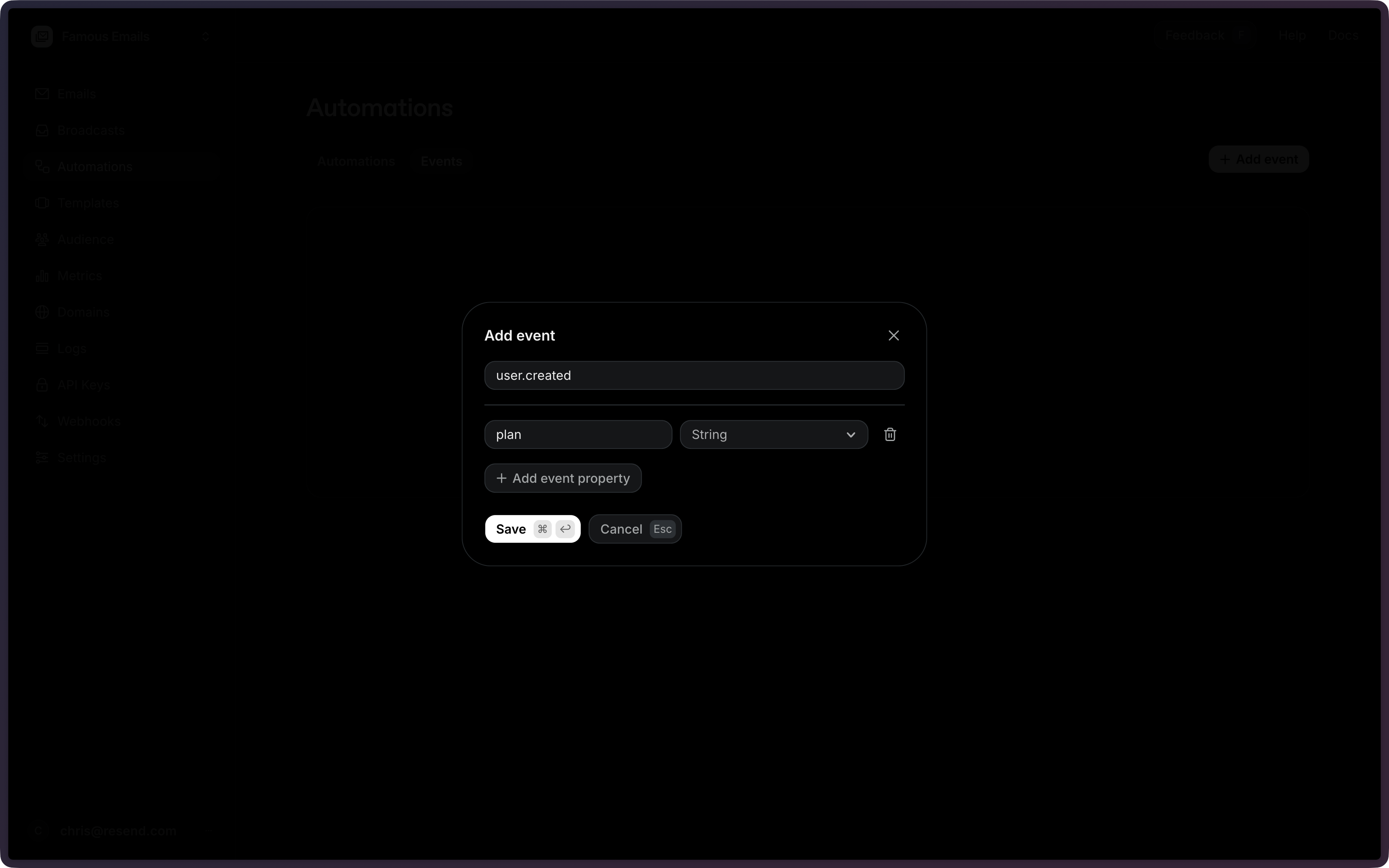 When you’re done, Save the event.
The event name can be any string (e.g., user.created, welcome, my-custom-event). Dot notation is a recommended convention but is not required. If multiple enabled automations use the same event name, all of them will be triggered.
Using the API
All existing events can be retrieved using the List Events API.To create a new event, use the Create Event API.
The event name can be any string (e.g., user.created, welcome, my-custom-event). Dot notation is a recommended convention but is not required. If multiple enabled automations use the same event name, all of them will be triggered.
View the Create Event API reference for the full endpoint specification.
[
](#configuration)
Configuration
[
](#param-config-name)
config.name
string
required
The name of the custom event to create. Used to match events to automation triggers.
Event names cannot start with the resend: prefix, which is reserved for system events.
[
](#param-config-schema)
config.schema
object
An optional schema definition for the event payload. Must be an object with flat key/type pairs. Supported types: string, number, boolean, date.
Example
{
  "schema": {
    "plan": "string",
    "amount": "number",
    "date": "date",
    "is_active": "boolean"
  }
}